I love looking at all the books on writing and publishing. After the YA section, it's probably my favorite part of the bookstore. I mean, there's so much promise there. Write your novel this year! Write your novel in a month! No plot? NO PROBLEM. How to write science fiction. How to write short stories. How to write a sentence, a scene, a character. Plot-building, world-building, inspiration. I go into this part of the bookstore and I just feel like I need everything. I need to know how to create scenes and outline a plot and do writing exercises, right?
Right. Totally. Definitely.
So I start going through these books and flipping to random pages the way I do when I'm shopping for books and most of what I read is stuff I've heard before. Where is all the new information? Where is the magic formula for the perfect plot/character/scene/novel? Is it not here in this bookstore? OMG.
It always takes a while before I remember that reading another book on writing won't actually write my novel for me. It won't make it easier. It won't get me an agent or editor. It might give me more information, but without actually writing even that information won't be worth anything.
Thinking about writing won't finish the book.
Reading about writing won't finish the book.
Only sitting down and writing will finish the book. Or edit the book, rewrite it, polish it. Nothing accomplishes this except for actually working on it.
Of course, having said all of that... I actually did end up buying another writing book this time. I'm about a third of the way through The Art of War for Writers and so far I really like it.
Monday, February 28, 2011

Thursday, February 24, 2011
Stealing Time for Reading
I read very often. I read while eating, while online, between classes, and while watching television. Because apparently I think my mind can multitask like that.
But I hardly ever just read. Without doing something else, without paying attention to what time it is or what else I should be doing or anything else.
Last night though, I was so tired. I meant to come home and study and watch Friday Night Lights but I was too tired to even get my computer out of its case. I was like well, I'd have to plug it in. And then I'd have to go to Netflix. And I'd have to take all these books off my bed to have a place to put the computer... aw, forget it. So I just curled up among all those books on my bed and, because I was too tired to do anything else but didn't want to go to sleep (it was like eight o'clock) I started reading.
I don't know how long I read for. I know I got up eventually, took a shower, then came back and finished the book.
It was so much fun. I rarely take the time out to just focus on reading without having any other distractions and doing so reminded me of how great reading really is and how much I love it. So often I feel like I should be doing something else, usually schoolwork or my own writing. Honestly one of the reasons I loved reviewing books was because I felt that obligation to reading, like it was something else I had to do instead of feeling like it was taking away from other things.
Without that, I often feel like I'm "stealing time" to read (That said, I do steal a lot of time) and I'd like to get away from that viewpoint. I'd like to be able to devote even a little bit of time to reading without feeling like I should be focusing on something else instead.
What about you? Do you often feel like you should be doing something else with that time you spend reading? Do you tend to multitask read like I do or are you better at focusing on reading and nothing else?
Tuesday, February 22, 2011
The 50 Page Rule
Because there are so many amazing books out there, it's been a rule of mine for quite a while that I only have to read the first fifty pages of any book I start. If, at or after that 50 page mark, the book still hasn't hooked me, or I don't like it for some reason, I have full permission from myself to put it down and move on.
Guilt-free.
Lately though, I've been rethinking this. Not so much because I feel bad about not finishing books (though there is that, especially with ARCs), but because I've recently read a few books that weren't that interesting at the 50 page mark. It wasn't until page 60, or 70, or even 90, that I really felt myself become invested in the book. Some of these books, one in particular, are ones that I happily finished and really, really enjoyed.
So now I'm thinking about turning page 50 into page 75. Or 100. On the one hand there are those books that pick up after page 50, the ones that I'd be missing out on if I put down so early, but then on the other hand... most books that I'm not interested in at page 50 are ones I still won't like at page 100.
I don't know. I'M STUCK IN A QUAARRRY*. What do you suggest -- is 50 pages fair or too short? Do you have a similar rule when reading or are you one of those readers who finishes every single book?
*"Parties are like frisbees. If you throw them the wrong way, they'll veer off in a bad direction and then your kid will fall into a quarry. Don't throw a party for vengeance. It will turn on you. Like your wife, after your kid has fallen into a quarry." (Tracy Jordan, 30 Rock) QUICK, TO THE BATMOBILE!!!
Monday, February 21, 2011
Help Me Choose A Book?
I'm trying to decide on another ebook to buy for my Kindle and obviously this is a really big decision. I have a few books I'm thinking of, but feel free to recommend something not on the list. (Don't worry too much about whether it's in ebook form... I'll check.)
Sunday, February 20, 2011
Television Wishes: Three Books
I'm a fan of television. Not only do I watch a lot of shows, but I watch them aggressively, if that's possible. While there are relatively few movies I can watch for two whole hours, I have no problem flying through a full season of a show in a couple of weeks. And I get excited about the shows; I honestly care what happens to the characters and love when something completely unexpected happens nearly as much as I love when something that's been building for a while finally happens.
I'm sure I will always love books the most, but as far as storytelling goes, television is in a unique place in that the stories get to stretch out over long periods of time and the characters grow and change as time goes on. Pam from season six of The Office is a much more mature and self-assured person than the Pam of season two was. Books, even long series, rarely have this ability.
That said, there are a few books, both stand-alones and series, that I think would be great bases for television shows.
Flirt Club
Cathleen Daly
Alright, so no offense to Hannah Montana & friends, but do you guys remember when Disney Channel used to have really good shows? (Sure, my definition of "really good" may be a bit tainted by the fact that I had a huge crush on Gordo, but whatever.) Let's turn back the clock to those days and then put Flirt Club into production because this novel about junior high drama geeks is hilarious, cute, and wonderful. I can just imagine it as an incredibly quirky and lovely "tween" show that, as an "adult" (I use that word very loosely in relation to myself) I would totally watch.
The Kid Table
Andrea Seigal
This book is pretty structured (the story is divided into five sections, each one detailing a family event at which the kid table members are present), but I think that could work really well for a television show. The book is focused on Ingrid Bell and her five cousins, a concept that I think would be awesome for a show, especially because the second I was done with The Kid Table I wanted more about Ingrid and her family. Think NBC's Parenthood meets Community with darker Dexter-esque* undertones. Yeah, I think that could be most excellent. I know I'd tune in weekly.
The Naughty List
Suzanne Young
Spy cheerleaders? Heck yes. This would totally satisfy my craving for another great spy show. (For some reason I just can't get interested in Chuck.) The Naughty List and its sequel, So Many Boys, follows a squad of high school cheerleaders who double as spies who catch cheating boyfriends. The book is fabulous, fun, and smart... just like the show would be. Plus, stereotype-defying is always awesome. The more I think about this one, the more I really, seriously want the tv show. UM, PLEASE.
*Okay, I've only seen a few episodes of Dexter. But it's definitely creepy and has that dark undertone and plus the main character in this book might be a psychopath.
Friday, February 18, 2011
The Best Feelings
A few days ago Khy from Frenetic Reader shared some of her favorite feelings about reading and I love that idea, so I'm stealing it. BECAUSE FRIENDS STEAL FROM EACH OTHER, RIGHT?*
1. I love it when a book pulls me in so well that I can't stop reading, that the pages just keep turning and even though I should do some laundry or homework or sleep or talk to my family I just cant. stop. reading. That's one of the most amazing feelings and even though I look at the clock later and hours and hours have past I so rarely regret spending a day on a truly great book.
2. I love when the title or cover of a book matches the book just so perfectly.
3. I love the lines or passages in books that I just feel the need to write down and save because they're either so pretty or relatable or hilarious. Sometimes, I confess, I'll reread a book just to find whatever great lines it has.
4. I love totally falling in love with a book. Geeking out, fangirling over it, and yelling about how impressive it is on Twitter and often telling my family and friends that they MUST READ IT OMG.
5. I love that moment right before turning to the first page of a book, that moment when anything is possible and this story could be the best I've ever read. That moment is so full of opportunity and anticipation and a leap of faith that when I begin reading this story I'll be in good hands.
There are so many other things I love about books and reading, but those are for another time.
Thursday, February 17, 2011
Book Love: Leverage
 |
| LEVERAGE Joshua C. Cohen Dutton |
I'm not joking when I say that this is, quite possibly, the most disturbing book I've ever read. Firmly rooted in reality and worst possible scenarios, Joshua C. Cohen paints a vivid portrait of two guys who, despite their obvious differences, are trapped in their fear and fighting for courage.
Kurt, the newest member of the football team, is an incredible character full of heart and a need to be bigger, tougher, stronger than anyone else so that nobody can hurt him. He's has plenty of weaknesses but more than makes up for them with how amazing and protective he is. On the other side of the story is Danny, a talented gymnast who finds an unexpected friendship with the hulking Kurt; in spite of the animosity that exists between their respective teams, neither of these boys realizes the horror they'll soon be wrapped up in.
You guys, this book is amazing. Amazing and gritty and horrifying and terrifying and incredible and written so well I almost can't believe it. Kurt has skyrocketed to a place on my list of Favorite Ever Characters while a few of his teammates earned themselves a place on the Characters Who Should Die Die DIE!!! list. And that list didn't even exist before this book. I can't stop thinking about it. I emailed the author before I'd even finished just to go OMG OMG OMG THIS BOOK. If you're a fan of Courtney Summers, if you like gritty, edgy contemporary, you should definitely read this book. I hesitate to recommend it to everybody, omg just because it is so intense and it doesn't shy away from the horribleness of the events. But really, truly, this is a great story. The characters are developed so well it's scary, the writing is incredible, and it's a story that stays with you well beyond the last page.
Wednesday, February 16, 2011
Tweets of Win, Edition 1
I maybe possibly overuse that little favorite star on Twitter, mostly because EVERYONE SAYS SUCH LOVELY AND HILARIOUS THINGS. Here are some of the best of the last couple weeks or so.
I am literally watching paint dry. As an experience, it is as advertised. -- @mssusieday (Susie Day)
two roads diverged in a wood, and i -- i took the one less traveled by, and that is exactly why i keep my iPhone on me at all times. #GPSFTW -- @taherehmafi (Tahereh Mafi)
Dear hot chocolate, thanks again! Please give my best to whipped cream. -- @birbigs (Mike Birbiglia)
Goodnight Everything. If you secretly stop existing while I sleep & only start again when I wake up, do not tell me. I'll only worry. -- @neilhimself (Neil Gaiman)
Tuesday, February 15, 2011
Character Love: Drea, Harmonic Feedback
 |
| HARMONIC FEEDBACK Tara Kelly Henry Holt & Company |
Reading a novel by an author I've never read before is always exciting, and even more so when it's a debut author. I'm never sure what to expect, haven't heard too much, and don't have other books to compare it to. I don't know the writing style or what sort of characters to expect.
And sometimes a character like Drea comes along. The protagonist of Harmonic Feedback, Tara Kelly's debut novel, is a teenage girl diagnosed with both ADHD and, as the doctor's say, "a touch of Asperger's." She's bluntly honest, socially awkward partly because she doesn't understand the implicit rules everyone else seems to live by, and hates being defined by her issues. She's a late bloomer, hasn't had a real friend in years, and gets anxious over things that other kids don't think twice about.
She's not the norm. Not in fiction and not, I think, in real life either. But - not to make this too personal - I related to her, saw some of my own problems reflected in her, and I think a lot of other readers will also. Lots of us are late bloomers, or have anxiety, or don't quite know the right thing to say and the right way to act. We don't understand what's expected of us and don't understand the things others say or the things they do. Most of us are a little separated from our peers. Drea just brings this to a slightly higher level and wears a label along with her issues.
Some characters I want to hug and reassure that everything will be alright. Others I aspire to be more like. With Drea though, I couldn't be sure that everything would work out and I saw too much of myself reflected to want to be like her, but I wished we could be friends. Drea is the sort of character who is realistically flawed, incredibly different, and absolutely win.
Monday, February 14, 2011
more of the same
I've read* 23 books so far this year and 6 of them have landed a spot on the favorites list. Or, as I call it, the Ace List. This is a pretty big percentage (26%) and maybe that's because I'm easy to please, or because I have a good idea of what books I'll like before reading them, or maybe this has just been a really good six weeks.
In any case, upon finishing each of these novels, from Anna and the French Kiss to Gayle Forman's upcoming Where She Went, I didn't feel content with just letting it be. I wanted, like I always do, to talk about the books. To recommend them to others and discuss how absolutely great they are.
And I haven't done that. I mean, I kind of have, but it's been haphazard and half-hearted since leaving Ten Cent Notes because I just don't know how to go about things anymore. Writing reviews, recommendations, even blog posts about book-related things, seems a bit daunting. And I know I'm over thinking things the way I always do, but I almost can't stop myself. I don't want to insult people, I don't want to be unprofessional, I don't want to screw things up for myself. I don't want to mess up and the truly scary thing is that I'm not even sure where the line is... what's the difference between a nicely-stated viewpoint and insulting another person? Sometimes the difference between the two is just so thin.
The truth, blog-friends, is that I miss book blogging. Not just reviewing, but all of it. I miss sharing my thoughts on books, miss taking about YA-related issues, miss the discussion posts and opinions and the community that went along with it. What I miss most of all though, is just talking about books. Sharing the books I love and telling you why I love them and convincing others that, yes, they really are that good. I miss being a book person, and having a bigger role in the complex mechanism of publishing and books than a reader normally has.
I feel like I'm cheating on my writing-self by having a blog about reading. Maybe I shouldn't feel that way, but I do. I heard so many times that you must choose between being a (public) reader and being a writer, that once you choose to pursue publication you give up the right to share opinions freely the way a non-writing reader might -- I've heard these things and listened to them and let that choice work its way into my brain. And I hate it for more than one reason, but mostly because blogging and reviewing was something I loved. It made me happy. I'm willing to give it up in order to be a writer; I haven't blogged in the past few days because, honestly, maybe I am giving it up. Completely. Or at least, that's what I thought. It's really difficult to make a firm decision when there really are no hard and fast rules, when you're choosing between two things that you feel shouldn't even be a choice.
Should I stop the critical/negative reviews and only feature books I love, ones I can fully recommend? Yeah, okay, yes. I get that, I get it 100%. But what about the rest of it? Talking about different issues in books, discussions and opinions and lists of favorites? Should I stop those too? At the risk of offending someone whose book I don't love quite as much, should I stop everything, put the kibosh on discussing my reading and books online, in public? I don't know. That is the hardest decision, especially for me: someone who values honesty and respect and love and kindness over so much else. Someone who tries so hard to be nice and supportive and, in a word, good.
I wish this post had a nice, tidy conclusion, but it doesn't. Partly because things rarely are that nice and tidy and partly because I'm too hungry to think of the appropriate ending unless that ending involves bread or soup.
*or started to read at least, since I haven't finished one of them.
Wednesday, February 9, 2011
i'm a bear, etc. (sleepwalk with me)
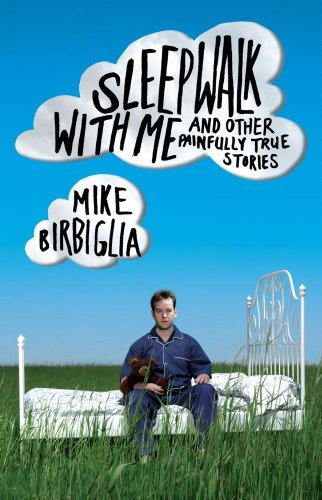 |
| SLEEPWALK WITH ME Mike Birbiglia Simon & Schuster |
To be completely upfront about it, I love Mike Birbiglia. He's my absolute favorite stand-up comedian; he manages somehow to tap into the awkwardness of life in a completely authentic way, possibly because he really is that awkward. Which is nice. Because he reminds me of myself. In his book he unearths such painful memories as his first love, the time he maybe had cancer, and those terribly personal family stories. Starting the book by explaining that his dad always told him not to tell people anything even the slightest bit personal sets the stage for Birbiglia to write down and share the most personal stories.
And it's funny, which is an understatement. This book is laugh out loud while reading funny, which is a particular hard-to-achieve brand of humor. Of course, it helps if you're familiar with Birbiglia's stand up (which is also excellent). And while being hilariously funny, the book also manages, somehow, to be incredibly sad. It's this bittersweet mix of hilarious and tear-jerking that works so perfectly and is all the more powerful just because it's so rare to find. Going into this book I expected to laugh, because Bahooski** is a funny guy. I also knew that some of the stories would be personal. I wasn't prepared, however, for just how perfectly he would capture the events, emotions, and bittersweet truths of life that he chooses to write about.
Mostly what I didn't expect was that this book would become so personal to me. I can only chalk it up to the fact that all of the unhappy truths Mike sees in himself (and then proceeds to write about, fortunately for us) are the same ones I see in myself, awkwardness being only one of many. Even if you don't often read memoirs or don't know who Mike Birbiglia is, I recommend this. Because it's awesome and amazing.
*I'M THE HULK, I'M THE HULK, I'M THE HULK!
**This is another inside joke for anyone who's read the book or heard/seen his stand-up. The above footnote is also an inside joke, btw. So many reasons to read this book!
Tuesday, February 8, 2011
my own rules
I've been doing some big thinking lately. Primarily I've been thinking about MY OWN PERSONAL BLOGGING RULES. Because while I don't want to offend anybody and definitely don't want to end up hurting anyone (including myself), I also want to talk about stuff.
And by stuff I mean books.
So I came up with some guidelines for myself, and while they're not exactly guidelines you need to know, I think it's nice to know what the blog you're reading is about. And what this blog is about (hopefully) is AWESOME THINGS.
AWESOME THINGS ABOUT BOOKS
- I'll be talking about and featuring the books I read and love. This isn't going to be limited to YA because my reading isn't limited to YA, but you can bet that the majority of books will fall under that umbrella.
- I'll talk about the authors I'm a big fan of. Not all of them probably, because there is a lot, but some of them.
- I will be doing discussion and opinion posts (often about the YA genre), but these discussions will never be about any specific book, series, or author.
AWESOME THINGS ABOUT OTHER STUFF
- I'll probably/maybe end up talking about television shows that I love. These include (but are not limited to): Community, The Office, 30 Rock, Parenthood, Friday Night Lights, and Cougar Town.
- And maybe (occasionally) movies. But there are very few movies I care enough to actually watch, much less spend time writing about.
- I might write the occasional personal post.
- I'll talk about geeky-awesome things such as: spies, robots, Star Trek, and Get Smart.
THINGS I'M NOT DOING
- The biggest thing I'm not doing on this blog are book reviews. While I will discuss the books I love, I won't be doing formal reviews anymore. But you knew that. (This does make me wonder if this could be considered a book blog -- can you have a book blog if you're not reviewing? Or is it called something else?)
- I won't be participating in IMM (In My Mailbox) anymore. Not because I don't love it but because I don't want to mention the books I'm reading and then not feature them and have someone think I hate their book. Note: I don't hate your book, just trust me on this.
- Unless I have big news, I won't be talking about my querying/publication journey much (if at all). Right now I have exactly two people who are privy to all of my query news and I like keeping this information fairly private.
I debated continuing to do discussion/opinion posts quite a lot and in the end I decided that my opinions are fairly innocuous. I'm not mean, a lot of what I say is pretty positive, and I doubt that opinions on something as general as genre will end up hurting me or insulting somebody. There's cautious and then there's paranoid. If I gave up voicing any opinions I'd have to stop blogging, and I think the positives of having a web presence probably outweigh the few less-than-great opinions I'll be sharing.
Do you think I can still consider this a book blog even if I'm not reviewing? Or is that the definition of book blog?
Monday, February 7, 2011
a memory of stupidity, or something
So, true story, in tenth grade I got a C on a math test. But wait wait, there's more! That's not even the good part yet!
I got a C on this math test and I was super-bummed because I literally did not understand anything we were doing and my teacher was super-unhelpful, and the guy sitting next to me looked over at my grade and said, "Wow, you're, like, one of those people who looks really smart but is actually dumb."
BLOG, WHAT DO YOU SAY TO THAT?
If you thought: "there is no answer" than you are correct. I sat there sort of duh-wee because seriously wth?
But he was right. I do look smart. I have that not-too-ugly-not-too-pretty, brunette, quiet, studious look about me. Like I'm thinking really big thoughts when most of the time I'm really thinking about something ridiculous, like robots falling in love or what would happen if I rammed the grocery cart into the back wall of the grocery store, where all the wine is, and how much wine would break and spill all over the place and could it possibly flood the aisle a little bit?
Those are actually things I think about. Often.
What strange things do you think about, blog? And also: do you look smarter than you are? Or are you smarter than you look?
Sunday, February 6, 2011
today let us think about robots!
Please feel free to share with me your robot-related thoughts while I do some thinking of my own.
Saturday, February 5, 2011
ennui is a really fun word, but also weird
In case you haven't noticed, and you obviously have, I don't quite know what I'm doing yet. I haven't quite figured out the rules of this blog - what I will talk about, what I won't, what the focus is. I'd love for this to be a blog that is, still, focused on books and YA lit, but I know the problems I ran into last time and I'm wary of posting anything that could cause problems. I still don't know where the line is.
And I know that if this is going to become just another book blog, then what was the point of me giving up Ten Cent Notes (where I had a solid readership and had put years of effort into the blog) in the first place? I have to remind myself constantly that I started this new blog for a reason, a clean start, a fresh perspective. However, as much as I'd love to look at things from the writer's POV... nobody wants to hear that. Or if that's not true here's what is:
I don't feel comfortable having a writing blog, because I am not a writer except in the loosest definition of the word. I'm not okay with giving you writing advice because, really, why should you listen to me? Talking from the perspective of a writer often means talking about writing, and while I love talking writing with friends and family (because my mother is obligated to listen to my writing-related rants), I'm less enthusiastic about blogging about it because I'm pretty sure it's only interesting to me.
So, uh, I'm not quite sure what I'm doing. I'm thinking about blogging about TELEVISION TELEVISION TELEVISION because I love television, but even that's something that I feel like would only interest me. And I do feel like, honestly, that small foothold I had into the world of YA lit has dissipated now that I'm not running a book blog and only occasionally talking about books on the blog. That really sucks, because I love YA and I love talking to other bloggers and being part of that community and feeling like I have a reason to talk to authors, like I'm not breaking some invisible wall between me and them. (True, this wall may only be in my mind, but it's still there.) I miss that and I'm not yet used to not talking books every day and sharing my opinions with people and writing book discussion posts about things that are bugging me or things I wish would change.
I'm sure it's just the fact that starting a new blog and quitting another puts you in an in-between, transition-y stage, and it hasn't been that long, really, but right now I do feel like books are the only interesting thing I have to talk about and omg omg what am I doing?
That's the question I'm trying to answer. So things are still going to be a bit rough around here for a few weeks while I figure it out.
But I don't know.
I'll figure it out eventually. Hopefully soon. The unending ennui is killing me slowly.
Friday, February 4, 2011
here's a question, blog
As you can maybe tell, I'm still working on the whole figuring out what this blog is going to be thing. With a book blog, it was easy: book reviews, discussions, lists, favorites. This time around, it's a bit more difficult. I want to talk about books but how much is too much? I want to talk writing, but don't want to talk about my querying process and don't especially feel qualified to give writing advice.
So I must turn to you, blog, and ask WHAT DO YOU WANT TO TALK ABOUT? Or, erm, what do you want me to talk about?
So I must turn to you, blog, and ask WHAT DO YOU WANT TO TALK ABOUT? Or, erm, what do you want me to talk about?
Thursday, February 3, 2011
a disclaimer of sorts
When I ran a book review blog one of the big reasons I didn't only review books I liked was because I wanted people to trust me. I didn't want to be fangirling all over books that didn't deserve it -- and I wanted to present a balanced view of even those books where all I really wanted to do was shout YES, THIS! THIS IS GOOD! BUY THIS! READ THIS!
I miss that. I miss the detailed, super-balanced reviews.
I miss it because I know, I know, the books I love aren't going to be the ones you love. Just because I think a book is super-fantastic-wonderful doesn't mean you will and there is a part of me that feels bad about essentially only presenting half of the story when it comes to books. Every book I feature on this blog will be one I love. One that I can wholeheartedly recommend, one that's good enough to reread, one that belongs on my Goodreads favorites shelf.
Now, when I tell you about a book, it's because I honestly love that book. It's worth reading. My recommendations will probably never be as in-depth as my reviews were, but they will still - of course - be honest. I'm telling you this because a lot of times when I see blogs where every review is glowing and they never mention the negatives of a book (because, let's face it, most books aren't perfect), I lose a little bit of trust in that reviewer.
But I'm not a reviewer anymore.
And I love the books that will be featured here.
And I hope you will too.
Wednesday, February 2, 2011
welcome to this place where things happen
I love television. I say this in a completely sincere, 100% earnest way. What's more, I'm pretty sure television can help us be better writers. Today is part one in what I'm hoping will be a series of posts showing HOW TELEVISION CAN TEACH US IMPORTANT WRITERLY LESSONS. Psh, yeah.
HELLO, SETTING.
I'm a sucker for setting. Show me a story with a strong, authentic setting and I can forgive just about anything else. Unfortunately, setting isn't exactly easy to write. We forget how important it can be, what an impact it can have on the feeling of the story. And while in a novel it's easy to forget about the setting, let it slide to the back of our minds or fall by the wayside, this is rarely the case in television shows, where the setting is often at the forefront. And in a good way. With the help of four of the best shows of ever, I'm going to tell you why setting is so important and why it can be so incredibly awesome. (And as great as these shows are, I'm betting that maybe you haven't seen all four of them? That's okay. The lessons still apply. Maybe hit up Hulu/Netflix/1967 to check them out?) Also, there is so much more I could talk about with setting, so many other great television shows that have great examples, but for today...
 SETTING IS EVERYTHING.
As far as this show is concerned, the small, football-obsessed town colors every other aspect of the show from its storylines to the characters. You really need to watch the show to get the full effect, but I can honestly say that I can't think of anything that happens on the show that isn't true to the setting and that isn't, in large part, controlled by the setting. When football is your life, when you've lived in the same town with the same people forever (as most of these characters have), things that to many people are no big deal become huge. A loss on game day. A high school principal who enforces the No Pass, No Play rule when it comes to the school's football stars. In Texas, as they say, everything is bigger, and that's definitely true when it comes to this show. Friday Night Lights takes stories involving high school fights, sports, classes, and teenage relationships and elevates them to new heights. Everything matters in this show not only because of the great writing and characters, but also because of the backdrop it's set against: high school football in Texas.
ESTABLISH THE WHERE.
This setting works so well because they take the time to establish it from the very beginning. Instead of diving headlong into the story, the pilot episode of Friday Night Lights opens slowly, showing us the flat land of Texas, the stadium lights, and the team's new coach walking out across the football field just as the sun is peaking. Playing over this slow opening is the radio announcer, talking about the new season and the new coach, taking calls from listeners, and establishing not only the show's backstory but also, and more importantly for us, the setting. Just by these few opening moments the viewer knows things about the where of Friday Night Lights. We know this is Texas. We know it's a small town. And we know that high school football is the most important thing. Though first-page infodumps are a bad idea, there are ways to take a page out of the FNL playbook and establish the setting at the outset.
 SETTING IS CHARACTER.
Alright, I know I'm losing a lot of you by using a show that's almost fifty years old, but bear with me here because all you really need to know is that Get Smart is about spies. If you want to get technical about it this is a "workplace sitcom," but the important difference between this and, say, The Office is that being a paper salesman doesn't define Jim Halpert the way being a spy defines Maxwell Smart. These characters don't have lives outside of work because they are the job. And the job is the setting. This is shown a million little ways, from the fact that the main character reads a book called Bedtime Stories for Spies to the fact that one main character doesn't have a name, only a number.
PAY ATTENTION TO IMPACT.
Setting is not only the where of your story, it's often also the culture that permeates the story and characters. We do not and cannot exist independent of our environment and neither can characters. The point here is that oftentimes the setting or culture will, realistically, have a huge impact on your character's identity and this, in turn, will impact who the character is. Or, to put it another way:
 SETTING IS STORY.
As much as setting can make stories bigger, as in the case of Friday Night Lights, it often also limits what you can do with your story. Take the case of Community, which is set in a study group at community college. One of the reasons this show is so great is because it obeys the boundaries of its setting. Sure, the episodes' storylines are wacky and sometimes all over the place, but at the root of each episode is the Plausibility Factor: yes, this could actually happen in a community college. Whether they're putting on a drug awareness skit for middle schoolers or trying to cheat their way into classes that don't actually exist, these are things that could, conceivably, happen in the show's setting.
STAY IN THE LINES.
Creative is good. Weird is, depending on what you're writing, good. But the second you go beyond the boundaries of what could possibly happen, your setting loses credibility. Not only that, but the entire story itself loses credibility; it ceases to be realistic and you've just created another hurdle you have to overcome. Either color inside the lines of your setting, or ignore the setting altogether. Though setting is important, disregarding it is often worse than ignoring it altogether.
 SETTING IS DEVELOPMENT.
So far all the shows I've mentioned have had settings that more or less stay the same throughout the series' run. But what about shows like Gilmore Girls, where the setting changes. Partway through the series one of the title characters goes off to college and the show follows her as she leaves her small and super-quaint hometown for Yale University. And guess what? It works. The show changes, but because this change goes along with the development of the show it ends up working to the advantage. Characters don't always stay in the same place. Stories don't always happen in the same place. Switching things up partway through presents a difficult challenge, but if handled right it can be incredibly useful.
STAY TRUE TO YOUR ROOTS.
One thing Gilmore Girls does absolutely right is to keep the backbone of its show even while changing the setting. The strong mother-daughter relationship is still at play and the charming town of Stars Hollow is still a part of the show because one main character still lives there. By keeping the root of the show very much alive it not only gives the series stability but also serves to show how much the daughter's character has changed. It works for contrast and familiarity. If you do change the setting in your story, do it deliberately, do it carefully, and be sure to stay true to the roots because that original setting is at the core of your story.
To sum up:
HELLO, SETTING.
I'm a sucker for setting. Show me a story with a strong, authentic setting and I can forgive just about anything else. Unfortunately, setting isn't exactly easy to write. We forget how important it can be, what an impact it can have on the feeling of the story. And while in a novel it's easy to forget about the setting, let it slide to the back of our minds or fall by the wayside, this is rarely the case in television shows, where the setting is often at the forefront. And in a good way. With the help of four of the best shows of ever, I'm going to tell you why setting is so important and why it can be so incredibly awesome. (And as great as these shows are, I'm betting that maybe you haven't seen all four of them? That's okay. The lessons still apply. Maybe hit up Hulu/Netflix/1967 to check them out?) Also, there is so much more I could talk about with setting, so many other great television shows that have great examples, but for today...
As far as this show is concerned, the small, football-obsessed town colors every other aspect of the show from its storylines to the characters. You really need to watch the show to get the full effect, but I can honestly say that I can't think of anything that happens on the show that isn't true to the setting and that isn't, in large part, controlled by the setting. When football is your life, when you've lived in the same town with the same people forever (as most of these characters have), things that to many people are no big deal become huge. A loss on game day. A high school principal who enforces the No Pass, No Play rule when it comes to the school's football stars. In Texas, as they say, everything is bigger, and that's definitely true when it comes to this show. Friday Night Lights takes stories involving high school fights, sports, classes, and teenage relationships and elevates them to new heights. Everything matters in this show not only because of the great writing and characters, but also because of the backdrop it's set against: high school football in Texas.
ESTABLISH THE WHERE.
This setting works so well because they take the time to establish it from the very beginning. Instead of diving headlong into the story, the pilot episode of Friday Night Lights opens slowly, showing us the flat land of Texas, the stadium lights, and the team's new coach walking out across the football field just as the sun is peaking. Playing over this slow opening is the radio announcer, talking about the new season and the new coach, taking calls from listeners, and establishing not only the show's backstory but also, and more importantly for us, the setting. Just by these few opening moments the viewer knows things about the where of Friday Night Lights. We know this is Texas. We know it's a small town. And we know that high school football is the most important thing. Though first-page infodumps are a bad idea, there are ways to take a page out of the FNL playbook and establish the setting at the outset.
Alright, I know I'm losing a lot of you by using a show that's almost fifty years old, but bear with me here because all you really need to know is that Get Smart is about spies. If you want to get technical about it this is a "workplace sitcom," but the important difference between this and, say, The Office is that being a paper salesman doesn't define Jim Halpert the way being a spy defines Maxwell Smart. These characters don't have lives outside of work because they are the job. And the job is the setting. This is shown a million little ways, from the fact that the main character reads a book called Bedtime Stories for Spies to the fact that one main character doesn't have a name, only a number.
PAY ATTENTION TO IMPACT.
Setting is not only the where of your story, it's often also the culture that permeates the story and characters. We do not and cannot exist independent of our environment and neither can characters. The point here is that oftentimes the setting or culture will, realistically, have a huge impact on your character's identity and this, in turn, will impact who the character is. Or, to put it another way:
Setting = Culture --> Identity --> Character.
As much as setting can make stories bigger, as in the case of Friday Night Lights, it often also limits what you can do with your story. Take the case of Community, which is set in a study group at community college. One of the reasons this show is so great is because it obeys the boundaries of its setting. Sure, the episodes' storylines are wacky and sometimes all over the place, but at the root of each episode is the Plausibility Factor: yes, this could actually happen in a community college. Whether they're putting on a drug awareness skit for middle schoolers or trying to cheat their way into classes that don't actually exist, these are things that could, conceivably, happen in the show's setting.
STAY IN THE LINES.
Creative is good. Weird is, depending on what you're writing, good. But the second you go beyond the boundaries of what could possibly happen, your setting loses credibility. Not only that, but the entire story itself loses credibility; it ceases to be realistic and you've just created another hurdle you have to overcome. Either color inside the lines of your setting, or ignore the setting altogether. Though setting is important, disregarding it is often worse than ignoring it altogether.
So far all the shows I've mentioned have had settings that more or less stay the same throughout the series' run. But what about shows like Gilmore Girls, where the setting changes. Partway through the series one of the title characters goes off to college and the show follows her as she leaves her small and super-quaint hometown for Yale University. And guess what? It works. The show changes, but because this change goes along with the development of the show it ends up working to the advantage. Characters don't always stay in the same place. Stories don't always happen in the same place. Switching things up partway through presents a difficult challenge, but if handled right it can be incredibly useful.
STAY TRUE TO YOUR ROOTS.
One thing Gilmore Girls does absolutely right is to keep the backbone of its show even while changing the setting. The strong mother-daughter relationship is still at play and the charming town of Stars Hollow is still a part of the show because one main character still lives there. By keeping the root of the show very much alive it not only gives the series stability but also serves to show how much the daughter's character has changed. It works for contrast and familiarity. If you do change the setting in your story, do it deliberately, do it carefully, and be sure to stay true to the roots because that original setting is at the core of your story.
To sum up:
- Establish the setting early on. This can be done through dialogue, important details, and internal monologue; just make sure it's not an infodump.
- Remember that, in stories where the setting is at the forefront, it should color everything.
- Realize the ways that the setting or culture of your story has shaped your characters and show that your characters are, at least in some ways, a reflection of their environment.
- Know that with a setting comes certain boundaries. Make sure your plot works within these boundaries.
- It's better to ignore setting altogether than to implement it only for it to be disregarded later.
- If you must change the setting of your story, make sure it works with the development of either character or plot. And always, always be careful in switching things up, realizing how much it will impact the story.
What television shows do you think writers can learn from? What helps you with building a great setting?
Tuesday, February 1, 2011
the first rule of flirt club has been broken*
And I love it - did I mention that? Not only do Cisco and the Bean remind me of me and the friends I had in middle school, not only are their problems real things that girls go through, but more than anything this story brought me right back to middle school and my own super-geeky times. Reading their notes to each other is like reading my journal, age 12, minus all the mortification that comes from knowing that actually happened to me. This book had me laughing out loud (for real) so many times and I just wanted Cisco and the Bean to be my best friends. The things that these girls are into aren't Justin Bieber or Hannah Montana, but stage productions and shows from the 60s. There are Star Trek references. The girls have secret agent numbers and that definitely has something to do with Get Smart. (You can just imagine my giddy, geeky happiness at finding this out.)
I love these girls. I love their story. I love the book. Because they're wonderfully quirky and great, because their friendship is honest and real, because there's an authentic level of geekdom here, because the whole book is hilarious, because their secret agent numbers are 88 and 66.
*The first rule of Flirt Club? Don't talk about Flirt Club, obviously.
Subscribe to:
Posts (Atom)